
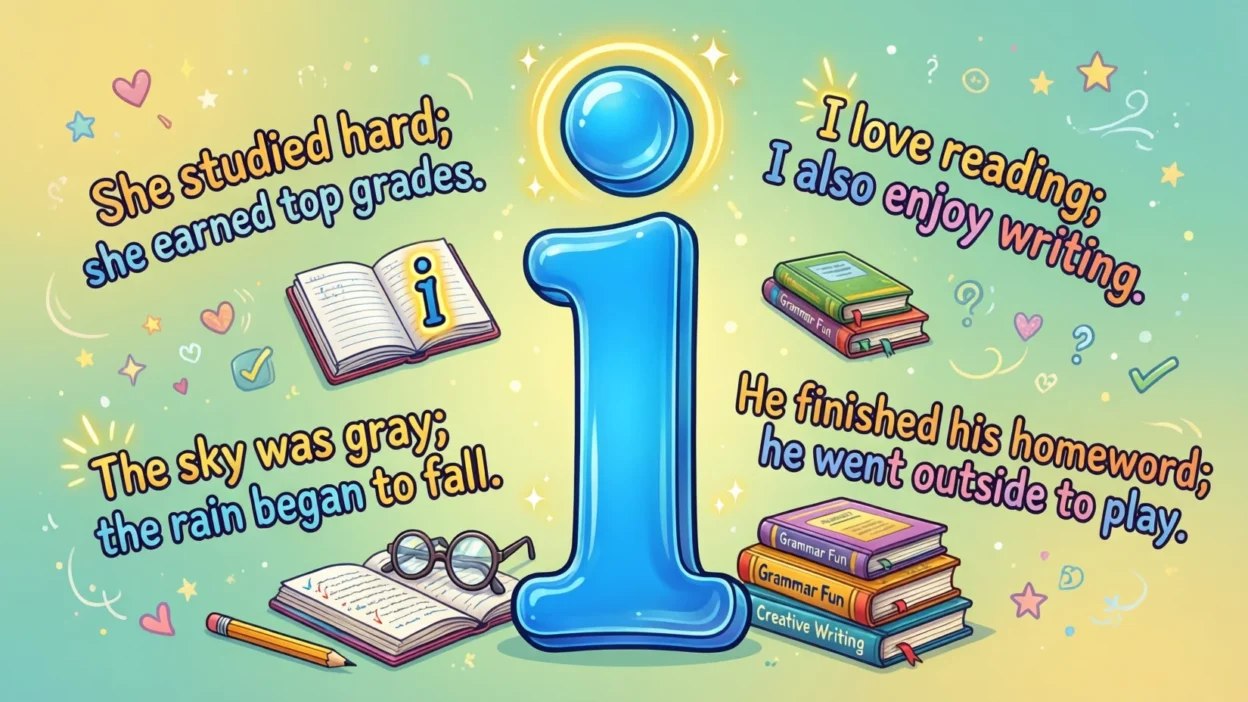
Learning about punctuation helps us write clearly and confidently. Among punctuation marks, the semicolon ( ; ) often puzzles learners.
It’s not as simple as a period or comma, yet it plays an important role in making writing stronger.
This guide explains the semicolon symbol meaning in a fun and easy way for kids, students, teachers, and parents.
1. What Is a Semicolon Symbol?
A semicolon is a punctuation mark that looks like a comma with a dot above it: ;
It sits between a period (full stop) and a comma in strength—stronger than a comma, weaker than a period.
Examples:
- I studied hard; I passed the test.
- We brought snacks; however, we forgot drinks.
Tip: Think of it as a “strong comma” joining closely related ideas.
2. Semicolon Meaning in Simple Terms
A semicolon tells the reader there’s a connection between two ideas—more than a comma but less final than a period.
Sample Sentence:
She loves art; her brother prefers sports.
Why?
The ideas are related but could be separate sentences.
3. When Should You Use a Semicolon?
Use a semicolon:
- Between two independent clauses (complete thoughts).
- In lists that already use commas.
- Before transitional words or phrases joining sentences.
4. Independent Clauses and Semicolons
An independent clause is a group of words that can stand alone as a sentence.
Example:
I like reading; the book was interesting.
Lesson:
Each part could be its own sentence, but the semicolon links them.
5. Semicolons vs. Commas: What’s the Difference?
- Comma (,): Joins smaller parts within a sentence.
- Semicolon (;): Joins larger ideas.
Example:
We ate pizza, fries, and cake; then we played games.
Tip: If a comma feels weak between two ideas, try a semicolon.
6. Semicolon vs. Period (Full Stop)
Period: Ends a sentence.
Semicolon: Connects two related sentences.
Example:
I wanted to call him. I forgot his number.
I wanted to call him; I forgot his number.
Tip: The semicolon emphasizes connection.
7. How to Use a Semicolon With Conjunctive Adverbs
Words like however, therefore, moreover, consequently often come after semicolons.
Example:
She studied for the exam; however, she was still nervous.
Tip: Put a comma after the conjunctive adverb.
8. Semicolons in Lists With Commas
When list items contain commas, semicolons separate items clearly.
Example:
We invited Tom, my cousin; Sarah, my neighbor; and Juan, my classmate.
Tip for Kids:
Semicolons help when commas alone get confusing!
9. Meaning of Semicolon in Writing Style
Semicolons show writing maturity by connecting related thoughts smoothly and clearly.
Example Comparison:
Weak: I like cats. I also like dogs.
Stronger: I like cats; I also like dogs.
10. Semicolons in Formal vs. Informal Writing
- Formal writing: Often used correctly for clarity.
- Informal writing: Less frequent; might be replaced with periods.
Example:
We planned the trip; however, it was canceled.
11. Semicolons in Creative Writing
Writers use semicolons to control pace and rhythm.
Example:
Her heart raced; her mind buzzed with questions.
Tip: Read aloud to feel the rhythm.
12. Semicolon Symbol Meaning in Poetry
Poets use semicolons to balance lines and control flow.
Example:
Soft rains fall; memories linger.
Tip: Semicolons can create gentle pauses in poetic lines.
13. The Emotional Symbolism of a Semicolon
In recent years, the semicolon has taken on emotional meaning.
It symbolizes continuation rather than ending—especially in mental health awareness.
Meaning:
Just as a semicolon continues a sentence, choosing to continue in life matters.
14. History of the Semicolon Symbol
The semicolon was invented in the 15th century by an Italian printer to link related ideas. It grew to become a staple in English punctuation.
Fun Fact:
It’s been used for over 500 years!
15. How to Teach Semicolons to Kids
Steps:
- Show semicolon shape.
- Compare to comma and period.
- Use simple sentences.
- Practice through games.
Example Game:
Combine two short sentences with a semicolon.
16. Common Semicolon Mistakes to Avoid
Mistake 1: Using a semicolon before a sentence fragment.
Incorrect: I ran fast; because I was late.
Correct: I ran fast because I was late.
Tip: Both sides must be complete sentences (unless using lists).
17. Exercises With Semicolons (Beginner)
Task: Combine these sentences using semicolons:
- I like ice cream. It is summer.
- He drew well. He felt proud.
Answer:
- I like ice cream; it is summer.
- He drew well; he felt proud.
18. Interactive Semicolon Practice for Kids
Ask kids to find semicolons in storybooks, then explain why they are there.
Tip: Look for connections between ideas.
19. Semicolons in Dialogues (Conversations)
In dialogue writing, semicolons can appear in speech where the speaker links ideas.
Example:
“I wanted to go; I just didn’t have time,” she said.
20. Semicolons in Academic Writing
Students should use semicolons to show relationships between ideas in essays.
Example:
The climate is changing; scientists warn of long-term effects.
21. Why Writers Love Semicolons
Writers use semicolons to make ideas flow and connect thoughts that belong together.
22. Semicolons in Digital Writing
Even online, semicolons help clarity—especially in long social media posts or blogs.
23. Semicolon Meaning in Different Languages
In many languages, semicolons serve similar roles, though rules may vary slightly.
24. How to Proofread Semicolons
Checklist:
✔ Are both sides complete sentences?
✔ Is it stronger than a comma?
✔ Does it improve flow?
25. Semicolon Symbol Meaning in Coding
In many programming languages, a semicolon ends a statement.
Example (JavaScript):let x = 5;
Tip: In coding, it often acts like a period.
26. Visual Ways to Remember the Semicolon
Picture it as a comma holding up a dot—a pause…but alive.
27. Why Semicolons Matter for Clear Writing
They help keep related ideas together, making thoughts easier to follow and stronger.
28. Semicolons vs. Colons: What’s the Difference?
Colon ( : ) introduces lists or explanations.
Semicolon ( ; ) joins related sentences.
Example:
I bought three things: apples, milk, and bread.
I went home; I began to study.
29. Real‑Life Semicolon Examples
- I woke up early; the sun was already shining.
- She packed her bag; then she left for school.
30. Semicolon Strategies for Tests
If unsure:
- Replace with a period.
- If both parts still make sense, semicolon is okay.
31. Semicolons in Short Stories
Short story writers often use semicolons to slow the pace and build mood.
32. Semicolon Symbol Meaning for English Learners
Learners of English can think of it as a friendly bridge between full thoughts.
33. Tips to Remember Semicolon Rules
- Use between two complete thoughts.
- Use in complex lists.
- Use before words like however.
34. Quick Semicolon Rules Summary
- Link related sentences.
- Separate complex list items.
- Use with conjunctive adverbs + comma.
35. Common Examples You See Everyday
- Recipes
- Instructions
- Articles
- Essays
36. Fun Semicolon Activities
- Sentence matching games
- Punctuation treasure hunts
- Story building with semicolons
Conclusion
The semicolon symbol ; may seem tricky at first, but it is a powerful tool in writing. It helps connect ideas clearly, organize complex lists, and bring flow to your sentences.
If you’re a student learning grammar, a teacher guiding young writers, or a parent helping homework, the semicolon has a meaningful place in language. With practice and clear examples, you’ll use it confidently in writing and communication.
FAQs
Q1: What is a semicolon used for?
A semicolon connects closely related sentences or separates complex list items, making writing clearer and smoother.
Q2: Can a semicolon replace a comma?
Not exactly. A semicolon is stronger than a comma and links independent clauses, whereas a comma is used for smaller pauses.
Q3: How is a semicolon different from a colon?
A colon introduces lists or explanations, while a semicolon connects related sentences or separates complex list items.
Q4: Can kids learn to use semicolons?
Yes! With simple examples, games, and practice, children can understand and use semicolons effectively.
Q5: Why is the semicolon symbol meaningful in writing?
It helps writers connect ideas smoothly, organize thoughts, and make sentences easier to read.

Adam Crew is an American author known for his clear, engaging, and reader-friendly writing style.
He focuses on modern topics, symbolism, and real-life concepts explained in a simple way.
His work aims to educate, inform, and inspire a wide range of readers.
Adam Crew is a contributing writer at symbolisx.com, where he shares well-researched and easy-to-understand content.